
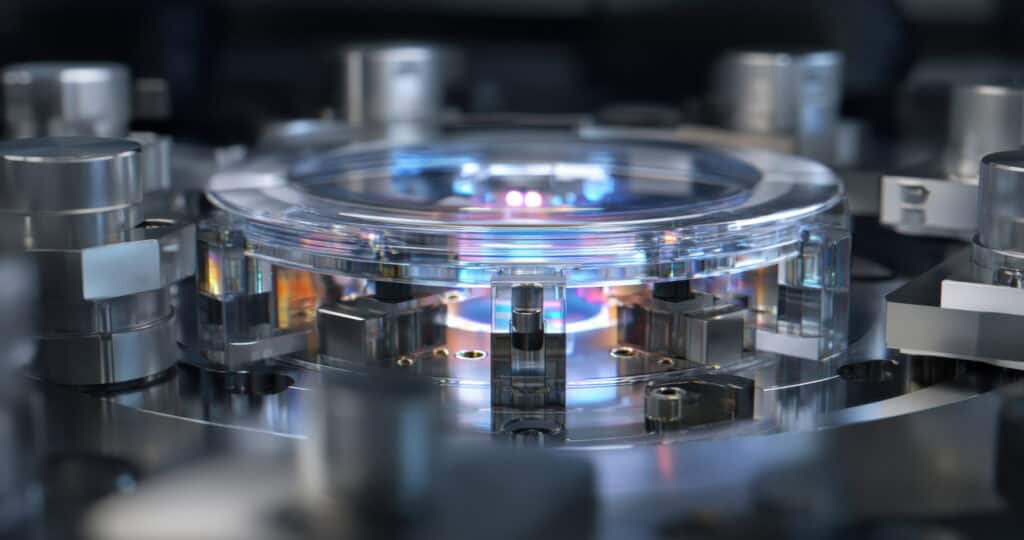
In the world of high-performance optics, precision is non-negotiable. These types of applications require high resolution positioning systems, advanced machine vision and laser technology. In some cases, high our ultra- high vacuum environments must be created where cleanliness is critical.
Keller Technology Corporation has recently manufactured and delivered a sophisticated metrology system designed to support the inspection and characterization of optical components. This project is part of a broader trend we’re seeing in the industry: organizations that design advanced optical
systems are increasingly turning to qualified contract manufacturers for the build-to-print execution of their specialized test equipment.
Our customer is a leader in photonic technologies and developed a set of proprietary requirements and detailed documentation for an instrument capable of qualifying optical assemblies at various stages of their production lifecycle. The system includes precision stages, piezo electric drives, electronic controls, and integrated optics including lasers and detectors – all with tight tolerances and requiring robust assembly procedures.
Rather than attempting to build the system in-house, the customer chose Keller Technology to manufacture, integrate, and validate the system to their specifications. This decision was based on our experience with high-complexity electromechanical builds, our clean and controlled manufacturing environment, and our ability to meet rigorous quality and documentation standards.
In optical and photonic markets, many OEMs develop their own specialized test processes but do not maintain internal resources for mechanical fabrication, precision integration, or system-level test. For these companies, outsourcing to a qualified manufacturing partner allows them to:
- Leverage internal engineering resources more efficiently
- Avoid building out specialized tooling and assembly infrastructure
- Reduce build risk for complex, one-off, or limited-run equipment
- Ensure quality without tying up internal production capacity
Our role is to bring the customer’s design to life accurately, reliably, and with full accountability for quality, schedule, and build documentation.
Our Approach to Build-to-Print Optical Test Equipment
1. Full Documentation Review and Bom Validation
Before production begins, our engineering and procurement teams conduct a thorough review of the design package including drawings, assembly procedures, and bill of materials. We identify any long-lead items, obsolescence and supply chain concerns, or missing details that could affect cost or schedule, and we work with the customer to resolve them proactively.
2. Clean, Precise Fabrication and Assembly
Optical test systems often require ultra-clean surfaces, specialized coatings, non-magnetic components, or alignment-sensitive hardware. Our facilities are equipped for precision machining, clean assembly, and handling of delicate parts. Our team follows documented work instructions and quality checklists derived from the customer’s documentation package, with traceability throughout
the build.
3. Integration of Motion, Sensors, and Optics
Even when the design is customer-supplied, integration of multi-discipline systems requires manufacturing expertise. Our technicians and engineers carefully install linear stages, fiber-optic components, power supplies, and control electronics per the assembly drawings. We apply precision alignment methods when specified, ensuring repeatable and reliable system behavior.
4. Functional Testing and Acceptance
For test systems, we often execute a factory acceptance test (FAT) at our facility to validate basic functionality before shipment. In this case, the customer provided test protocols for verification of motion, wiring, power-up procedures, and component response. Keller’s role is to execute these steps, document the results, and resolve any build-related issues before handoff.
5. Logistics and On-Site Support
Once complete, the system is carefully packed, shipped, and staged for final integration at the customer’s site. Keller can provide on-site support as needed including installation, commissioning, and training.
While Keller Technology offers full design and build services, many customers come to us with detailed engineering packages and need a contract manufacturer with to execute complex assemblies with precision and reliability.
Key Advantages We Offer in Build-to-Print Work
- Deep experience with high-mix, low-volume systems
- Expertise in opto-mechanics, automation, motion control, and vacuum systems
- Cleanroom assembly, quality inspection, and engineering support
- Full documentation, including as-built records, engineering change logs, and FAT results
Our teams are trained to spot and resolve manufacturability concerns, even in situations where design ownership resides with the customer. This allows for smoother builds and fewer surprises during test and integration.
For companies developing advanced optical assemblies, test equipment is a critical enabler of quality and performance. Yet building that equipment in production volumes is not always a core strength. By partnering with Keller Technology for build-to-print manufacturing, organizations can focus on what they do best: designing innovative optical systems. We provide the infrastructure, expertise,
and precision to bring those designs into reality, allowing our customers to scale with confidence and deliver exceptional performance.
Contact Keller Technology to explore how our people, precision machining, and engineering capabilities can support your next advanced manufacturing project.