Maintaining dimensional accuracy in large-scale precision fabrication is not easy. As parts get larger, challenges like material movement, weld distortion, handling, and machining constraints become more pronounced.
For customers requiring complex equipment, these are real concerns. A misaligned frame, distorted weldment, or out-of-tolerance surface can create issues that carry through assembly, integration, and final performance.
At Keller Technology, dimensional accuracy is not something we check at the end. It is built into the precision fabrication process from the start.
Why Dimensional Accuracy Matters
Large-scale fabrication projects often serve as the foundation for an entire system. If they are not right, everything that follows becomes more difficult.
- Assembly misalignment
- Increased rework or shimming
- Difficulty integrating precision components
- Reduced system performance
In high-complexity equipment, small deviations at the fabrication stage can turn into larger problems later.
Where Accuracy Challenges Come From
Large-scale fabrications behave differently than smaller machined parts. Common sources of variation include:
- Weld distortion from heat input and sequencing
- Material stress relief after welding or machining
- Handling and fixturing limitations for large components
- Tolerance stack-up across welded and machined features
Recognizing these factors is the first step in managing them.
Building Accuracy into the Process
Start with the Right Strategy
Successful precision fabrication begins long before production starts. Whether the project is design & build or build-to-print, planning is critical.
We focus on:
- Fabrication and machining approach
- Critical features and tolerances
- Areas prone to distortion
- Measurement strategy
In design & build work, we can influence the design early. In build-to-print, we review the design and identify risks before production.
Use Sub-Weldments Where It Makes Sense
Breaking a large fabrication into smaller sub-weldments helps maintain control.
This allows us to:
- Limit distortion to smaller sections
- Machine key features earlier
- Inspect components before final assembly
It also improves consistency across multiple builds.
Control the Welding Process
Welding is one of the main drivers of dimensional variation, so control is essential.
We rely on:
- Qualified weld procedures
- Defined weld sequencing
- Proper fixturing and clamping
- Controlled heat input
Managing these factors helps maintain geometry and reduce rework.
Plan for Machining After Welding
Machining is typically required to bring critical features into tolerance.
This involves:
- Identifying surfaces that require machining
- Leaving material for final passes
- Sequencing operations to minimize movement
Large-format 5-axis machining is often necessary for complex geometries.
Measure Throughout the Build
Dimensional verification should not be left to the end.
We measure at key stages:
- After sub-weldment fabrication
- After major weld operations
- Before and after machining
This approach helps identify and correct issues early.
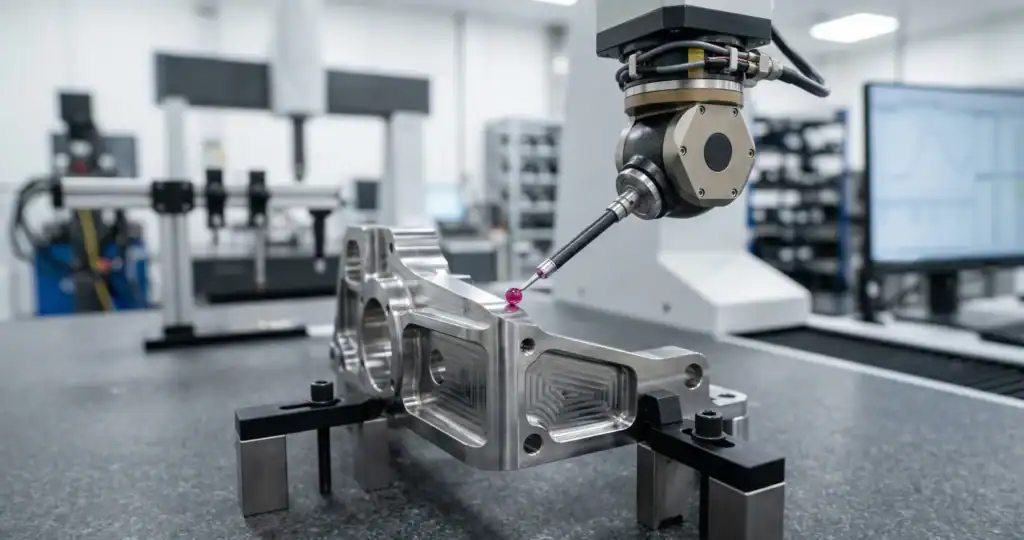
Use the Right Inspection Tools
Large-scalefabrication builds require appropriate inspection methods, such as:
- Laser trackers
- Portable CMM systems
- Precision layout tools
These tools allow accurate measurement without excessive handling.
Managing Tolerance Stack-Up
In large assemblies, tolerances can accumulate quickly. Managing this requires coordination across fabrication, machining, and assembly.
Key steps include:
- Identifying critical-to-function features
- Relaxing non-critical tolerances where possible
- Aligning inspection criteria with actual requirements
This is particularly important in build-to-print projects, where design intent must be maintained without overcomplicating execution.
How Keller Technology Approaches Large-Scale Fabrication
At Keller Technology, dimensional accuracy is a core part of our precision fabrication approach to high-complexity manufacturing.
Our process includes:
- Upfront review of fabrication and machining strategy
- Controlled welding and fixturing
- Use of sub-weldments to manage distortion
- Large-format machining for critical features
- In-process inspection and verification
- Clear documentation of results
Whether supporting a design & build effort or executing a build-to-print project, the objective is the same: deliver parts that meet specification without creating downstream issues.
Getting It Right Up Front
Large-scale precision fabrication is about control.
Achieving dimensional accuracy requires planning, disciplined execution, and the right combination of fabrication, machining, and inspection methods.
When done correctly, it simplifies assembly, improves performance, and reduces risk across the entire system.