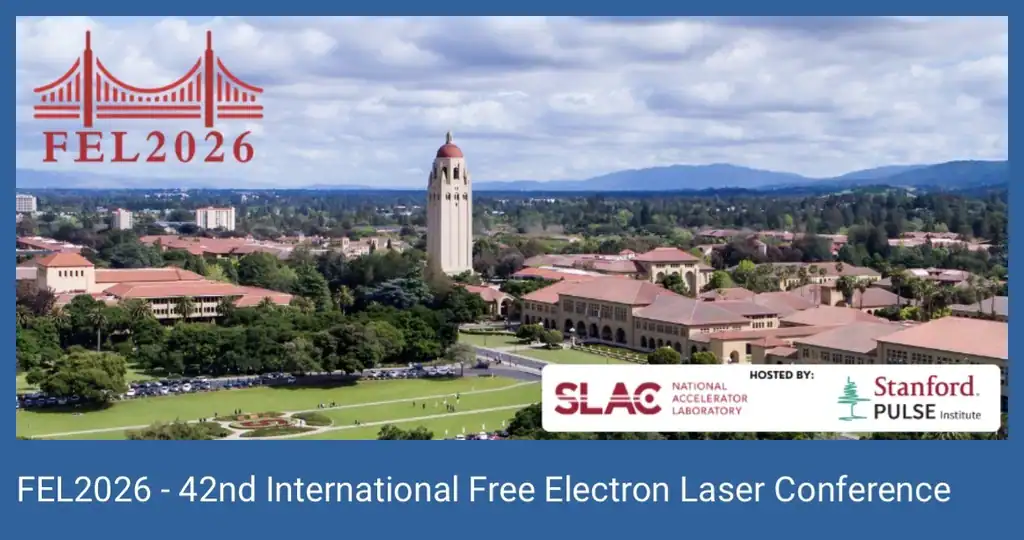
Keller Technology Corporation was proud to attend and sponsor FEL2026, the 42nd International Free Electron Laser Conference, held August 23–28, 2026, at the Li Ka Shing Center on the Stanford University campus in California.
FEL2026 brought together scientists, engineers, research institutions, and industry partners from around the world to discuss the latest advances in free-electron laser (FEL) technology. Hosted by SLAC National Accelerator Laboratory and the Stanford PULSE Institute, the conference covered developments in FEL theory and experiments, electron and photon beams, undulator technology, accelerator systems, and the expanding scientific applications of free-electron lasers.
For Keller Technology, the conference was particularly meaningful because of our long-standing involvement in the technologies that make advanced X-ray FEL facilities possible.
A Connection to LCLS-II
Keller Technology has been involved with the Linac Coherent Light Source II (LCLS-II) program for nearly a decade. Working with Lawrence Berkeley National Laboratory, Keller manufactured and integrated both hard X-ray (HXR) and soft X-ray (SXR) variable-gap undulators for LCLS-II at SLAC National Accelerator Laboratory.
Undulators are critical components of a free-electron laser. These precisely engineered arrays of powerful magnets cause high-energy electron beams to follow an oscillating path, producing the intense, coherent X-ray laser light that makes facilities such as LCLS-II extraordinary scientific tools.
Keller’s role included manufacturing mechanical systems, frames, and strong backs, as well as integrating, aligning, and measuring powerful rare-earth magnet assemblies to micron-level accuracy. The completed undulators became part of the approximately 100-meter undulator system where the electron beam is converted into X-ray laser light.
Undulator Technology Takes Center Stage
The FEL2026 program covered many areas closely aligned with Keller’s work, including accelerator systems, beam diagnostics, FEL concepts, and undulators and photon beamline instrumentation. Attendees also had the opportunity to tour LCLS-II and see these advanced technologies firsthand.
The conference provided a valuable forum for connecting with scientists, engineers, national laboratories, and industry partners advancing the next generation of free-electron laser technology.
From Scientific Concepts to Precision Hardware
Large-scale scientific facilities depend on more than innovative physics. They require highly specialized research equipment that can be manufactured, assembled, aligned, tested, and documented to demanding specifications.
That is where Keller Technology contributes.
Our work on programs such as LCLS-II demonstrates Keller’s ability to bridge the gap between advanced scientific designs and reliable, precision-engineered hardware. From complex accelerator and beam-delivery components to magnet systems, vacuum equipment, and one-of-a-kind research hardware, Keller works with national laboratories and scientific organizations to manufacture equipment for some of the world’s most demanding research applications.
We were pleased to support FEL2026 as a sponsor and to spend the week with the scientists, engineers, laboratories, and industry partners shaping the future of free-electron lasers.
Thank you to the FEL2026 organizers, SLAC National Accelerator Laboratory, Stanford PULSE Institute, and everyone who stopped by to connect with the Keller Technology team. We look forward to continuing to support the technologies behind the next generation of accelerator and X-ray science.